
Lewis County Scheduled Versus Actual Release
West Virginia uses several dates that answer different questions. A parole eligibility date under the West Virginia parole eligibility law marks when the Parole Board may consider release. A minimum discharge date is WVDCR's sentence computation. A scheduled or final release date is still a planned date until the custody event occurs. An actual release date records the completed departure. Treating any future date as proof of release creates a serious error.
For a person held at Central Regional Jail on a Lewis County matter, pretrial status usually turns on the court. Bond may be set, modified, or posted, but jail processing and other holds can still delay departure. A person serving a short county sentence may have a court end date and credited time, yet DCR maintains the custody transaction. A sentenced state prisoner follows the statewide prison, good-time, parole, and discharge framework.
Scheduled versus actual: A projected or minimum discharge date predicts an event. Only a release record confirms that the event occurred.
- PED
- Parole eligibility date, the point when Board consideration may become possible.
- MDD
- Minimum Discharge Date, WVDCR's scheduled sentence-discharge calculation.
- Actual release
- The recorded event when the person leaves that agency's custody.
- Mandatory supervision
- A period of correctional control in the community after institutional confinement.
Lookup Lewis County Inmate Release Dates
Choose the search by custody type. WVDCR's official gateway separates Daily Incarcerations, jail offenders, and prison offenders. A person booked on a Lewis County charge at Central Regional Jail belongs first on the jail and court path. A person committed to state prison belongs on the prison path. Statewide prison placement is not limited by the county of conviction.
- Identify the legal stage. Check whether the Lewis County case is pretrial, a county sentence, a prison commitment, parole, or a supervision violation.
- Use the WVDCR offender-search gateway and choose the jail or prison population that matches the case.
- Confirm identity with a second detail where the official record provides one. Similar names are not enough.
- Open the detail record and copy its exact date label. Do not rename PED, MDD, sentence expiration, or another field as an actual release date.
- Compare the latest WVDCR information with the Lewis County judgment, credited jail time, later court orders, and any Parole Board action.
- When the public interface is silent or unclear, request the current computation or release record from WVDCR.
The public prison interface could not be verified as retaining every discharged person or showing a literal “Projected Release Date” field for all records. A blank result may reflect spelling, population choice, visibility, or system limits. It does not prove release. The broader Lewis County released inmate record path explains how DCR custody data and court authority fit together.
For a regional-jail detainee, search the Lewis County magistrate case by first name, last name, or case number. A bond entry can explain the legal basis for a likely release, but it does not prove that DCR processing finished. If a felony matter moved to circuit court, request the signed order or docket sheet from the Lewis County Circuit Clerk. The court establishes authority; DCR confirms the custody event and any release time.
Note: Save the source, access date, and exact label whenever a release date is used for personal planning or a court-related inquiry.
Lewis County Minimum Discharge Dates
The reliable West Virginia term is Minimum Discharge Date, also written MDD/Final Release Date in WVDCR conditional-release policy. West Virginia Code §15A-4-17 requires WVDCR to give a committed inmate, or a person returned after a parole or supervised-release violation, a statement of sentence length and the computed time of minimum discharge. That calculation belongs to WVDCR. It should not be recreated from a news report or a docket sentence alone.
A court judgment supplies the sentence and may award presentence jail credit. WVDCR applies the custody data, eligible good time, sentence structure, exclusions, forfeitures, and restorations. A later order can also change the legal basis. If court arithmetic and a current DCR computation differ, preserve the conflict and request a new computation. Choosing the earlier date risks reporting an unsupported release.
WVDCR Policy 151.00 shows that the internal offender file can contain time sheets, supporting documents, transport orders, good-time restoration material, and parole decision summaries. That inventory explains why the agency can hold a fuller computation trail than the public search displays. It does not mean each internal item is public. Ask for the existing calculation or release record with enough detail to identify it, and allow lawful redaction.
The West Virginia good-time and minimum-discharge statute is shown below. Its text explains why the date is a statutory computation with several moving parts.
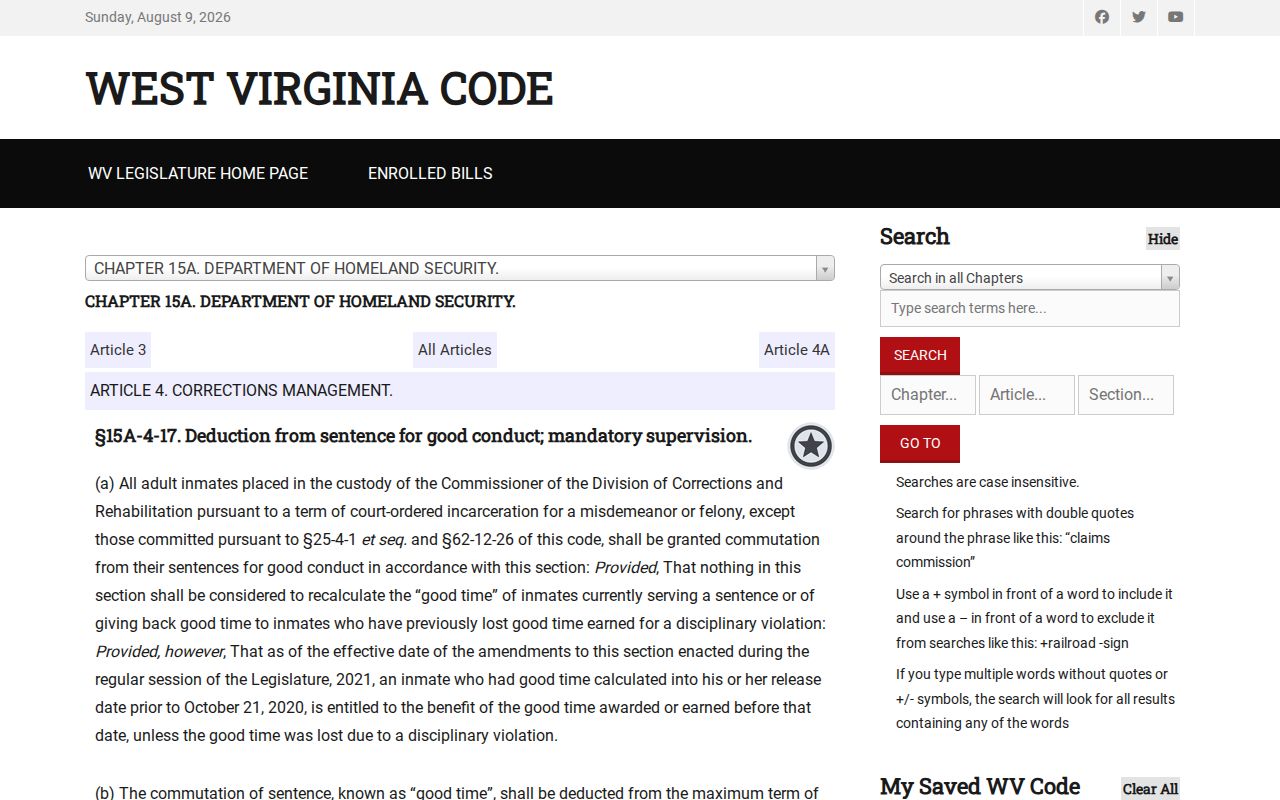
The image supports the one-for-one eligible good-time rule, but the current WVDCR statement remains the source for a named inmate's actual calculation.
Lewis County Good-Time Release Calculation
Under §15A-4-17, good time is deducted from the maximum term of an indeterminate sentence or the fixed term of a determinate sentence. An eligible inmate earns one day of good time for each day physically incarcerated. Credited presentence jail days can count when the sentencing court awards them under §61-11-24. Time on parole, bond, or another status outside physical incarceration does not count as an incarcerated day under this rule.
The framework is not an automatic promise of release at half the stated maximum. Eligibility, the credited start date, excluded offenses, consecutive sentences, court orders, discipline, parole decisions, detainers, and mandatory supervision can alter the result. A life-sentenced inmate receives no good time under subsection (d). Eligible consecutive sentences are added and treated as one sentence for this good-time purpose.
Extra good time can also arise in narrow situations. The statute permits an award for meritorious service or extra duties during emergencies. An eligible felony inmate may receive up to 90 days per approved optional academic or vocational program when that program was not required by the individual reentry plan. These fact-specific credits are another reason an outside release-date calculator cannot supply an authoritative answer.
Lewis County Has No 85-Percent Rule
West Virginia's one-for-one eligible good-time system should not be confused with the sentencing law of Virginia. The Lewis County research found no general West Virginia truth-in-sentencing statute that makes all inmates serve about 85 percent. The verified statewide basis is §15A-4-17, together with parole minimums and offense-specific restrictions. Importing a rule from another state gives the wrong answer.
One-for-one credit is still conditional. The law requires an initial minimum-discharge statement and a revised statement when forfeiture or restoration changes the earliest discharge. Good time can be forfeited for a disciplinary violation and may later be restored with the required approval. A date copied months earlier may therefore be stale even when it was accurate on the day it was recorded.
For planning, ask for the most recent MDD or final-release computation, its issue date, and whether a revision is pending. Then identify whether the date begins mandatory supervision or marks final discharge. Those are not the same outcome.
Note: “One day for one day” describes an eligible credit rule, not a guarantee that every sentence ends at the same fraction.
Why Lewis County Release Dates Change
A release date can move because the inputs and legal status change. Some factors alter sentence credit. Others change the authority to release or the destination. The newest source controls only within its own role, so a WVDCR computation, court order, and Parole Board action may all need review.
| Factor | Effect on the date or outcome | Best source |
|---|---|---|
| Good-time forfeiture | May move minimum discharge later after discipline | Revised WVDCR statement |
| Good-time restoration | May move the calculation earlier when approved | Revised WVDCR statement |
| Credited jail time | Changes the credited confinement used in computation | Sentencing order and DCR calculation |
| Consecutive sentences | Combines eligible maximum terms for good-time purposes | Judgment and WVDCR |
| Parole action | May allow conditional release, deny it, or defer a result | West Virginia Parole Board |
| Detainer or hold | May turn one agency's release into transfer to another | Custody and receiving-agency records |
| Later court order | Can modify the sentence or governing authority | Lewis County court file |
A parole grant may also depend on an approved home plan or assigned tasks. A PED only marks eligibility for consideration. When parole is denied, the Board provides a reconsideration month and year, but that month is not a projected release. Read the exact Board conclusion before linking it to a custody date.
Lewis County Mandatory Supervision Dates
Mandatory supervision can make the institution exit date look like final discharge when correctional control continues. For covered felony offenses involving violence against a person, a firearm, or a minor victim, §15A-4-17(k) removes one year from accumulated good time to create one year of post-release supervision. The provision applies to covered offenses committed on or after July 1, 2013, and requires electronic or GPS monitoring through that period.
For other felony sentences, subsection (l) permits a sentencing court to order up to 180 days, or a shorter period, of the sentence through post-release mandatory supervision. Release from a secure institution occurs, but the sentence has not become unconditional freedom from correctional control. Describe it as the start of mandatory supervision when that is what the record says.
Mandatory supervision is not parole. Parole is a discretionary Board release path. It is also not probation, which comes from a court sentence through the Judiciary. The three may look alike to a person checking a blank jail roster, but their orders, agencies, and discharge records differ.
Confirm Lewis County Actual Release Dates
Use a future date as a prompt for follow-up, not a completed event. West Virginia VINE can provide a custody-status check or notification for DCR regional jails and prisons. Its feed may lag, spelling matters, and transfer notice can wait until arrival at the receiving facility. An alert should be compared with the actual DCR release record and controlling court disposition.
For pending notice, the Lewis County VINELink release check explains person matching and registration. For an exact past date, ask WVDCR for the existing booking or release summary showing release date, time, type, and authority. The court record can explain why release was authorized, while DCR documents when its processing ended.
If the person left WVDCR for another custodian, report the narrow event. Transfer to another state, federal custody, or ICE is not community release. Likewise, parole or mandatory supervision ends institutional confinement but begins another status. Strong confirmation states both the agency that ended custody and the status that followed.
Note: A current MDD, an affirmative custody-change event, and the court order answer three different parts of a Lewis County release-date question.